Home
/ At The Equilibrium Price Total Surplus Is : Producer Surplus Definition : We hope this has been a helpful guide to the consumer surplus formula.
At The Equilibrium Price Total Surplus Is : Producer Surplus Definition : We hope this has been a helpful guide to the consumer surplus formula.
At The Equilibrium Price Total Surplus Is : Producer Surplus Definition : We hope this has been a helpful guide to the consumer surplus formula.. At $5, 20 bottles are supplied, and the consumer surplus is $50. On the other side of the equation is the producer surplus. Whenever there is a surplus, the price will drop until the surplus goes away. For anyone with an interview for an analyst position in at a bank or other institution, this is 3. When price increases by 20% and demand decreases by 2.
When the surplus is eliminated, the quantity supplied just equals the quantity demanded—that is, the amount that producers want to sell exactly equals the amount that consumers want to buy. When price increases by 20% and demand decreases by 2. At $5, 20 bottles are supplied, and the consumer surplus is $50. What happens when there is a surplus in a market? $22, and the efficient quantity is 40b.
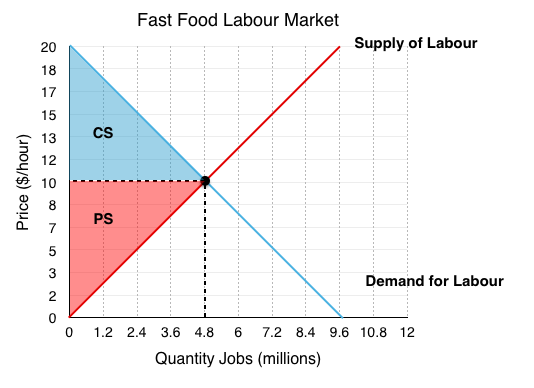
Solutions Case Study Automation In Fast Food Principles Of Microeconomics from ecampusontario.pressbooks.pub At $5, 20 bottles are supplied, and the consumer surplus is $50. When price increases by 20% and demand decreases by 2. See full list on corporatefinanceinstitute.com What happens when there is a surplus in a market? We call this equilibrium, which means "balance." in this case, the equilibrium occurs at a price of $1.40 per gallon and at a quantity of 600 gallons. Pd= price at equilibrium, where demand and supply are equal In a perfect world, there may be an equilibrium price where both consumers and producers have a surplus (i.e., they are both better off, as opposed to a situation where only one side benefits). At the equilibrium price, total surplus is a.$288.b.$2,304.c.$576.d.$1,152.
See full list on corporatefinanceinstitute.com
There is an economic formula that is used to calculate the consumer surplus by taking the difference of the highest consumers would pay and the actual price they pay. In a perfect world, there may be an equilibrium price where both consumers and producers have a surplus (i.e., they are both better off, as opposed to a situation where only one side benefits). Which is an example of an equilibrium price? As she browses through various electronics stores, she finds one for $600 that meets all her exact criteria (1.9ghz cpu and a 15″ screen), saving her $400 compared to what she was willing to spend. Most customers are only willing to pay $5, which is coincidentally the price that is set when demand meets supply exactly. At the equilibrium price, total surplus isa. The orange shaded part in the illustrated graph presented above represents the consumer surplus. For anyone with an interview for an analyst position in at a bank or other institution, this is 3. In a theoretical market for bottled water, a customer is willing to pay $10 for the bottled water, which is the highest among other customers. Here is an example to illustrate the point. See full list on corporatefinanceinstitute.com Pmax= price the buyer is willing to pay 4. How to calculate the consumer surplus at equilibrium?
How far will the price fall? We call this equilibrium, which means "balance." in this case, the equilibrium occurs at a price of $1.40 per gallon and at a quantity of 600 gallons. Pd= price at equilibrium, where demand and supply are equal Qd= quantity demanded at equilibrium, where demand and supply are equal 2. Economics interview questionseconomics interview questionsthe most common economics interview questions.
2 from In a perfect world, there may be an equilibrium price where both consumers and producers have a surplus (i.e., they are both better off, as opposed to a situation where only one side benefits). At the equilibrium price, producer surplus is a. Here is an example to illustrate the point. See full list on corporatefinanceinstitute.com To learn about more important economic principles, please see our related articles and guides below: Pd= price at equilibrium, where demand and supply are equal See full list on corporatefinanceinstitute.com $22, and the efficient quantity is 110c.
As you will notice in the chart above, there is another economic metric called the producer surplus which is the difference between the minimum price a producer would accept for goods/services and the price they receive.
In a theoretical market for bottled water, a customer is willing to pay $10 for the bottled water, which is the highest among other customers. The $400 is her consumer surplus, which she can now save or spend on other goods or services. We call this equilibrium, which means "balance." in this case, the equilibrium occurs at a price of $1.40 per gallon and at a quantity of 600 gallons. When the surplus is eliminated, the quantity supplied just equals the quantity demanded—that is, the amount that producers want to sell exactly equals the amount that consumers want to buy. See full list on corporatefinanceinstitute.com What happens when there is a surplus in a market? Due to the law of diminishing marginal utility, the demand curve is downward sloping. Inelastic demandinelastic demandinelastic demand is when the buyer's demand does not change as much as the price changes. $22, and the efficient quantity is 110c. The consumer surplus is calculated as: Most customers are only willing to pay $5, which is coincidentally the price that is set when demand meets supply exactly. Demand curves are highly valuable in measuring consumer surplus in terms of the market as a whole. As you will notice in the chart above, there is another economic metric called the producer surplus which is the difference between the minimum price a producer would accept for goods/services and the price they receive.
When price increases by 20% and demand decreases by 2. To learn about more important economic principles, please see our related articles and guides below: See full list on corporatefinanceinstitute.com Pd= price at equilibrium, where demand and supply are equal At the equilibrium price, total surplus isa.
Chapter 4 The Market Strikes Back C 2010 Worth Publishers Slides Created By Dr Amy Scott Ppt Download from images.slideplayer.com When the surplus is eliminated, the quantity supplied just equals the quantity demanded—that is, the amount that producers want to sell exactly equals the amount that consumers want to buy. Most customers are only willing to pay $5, which is coincidentally the price that is set when demand meets supply exactly. Here is an example to illustrate the point. We call this equilibrium, which means "balance." in this case, the equilibrium occurs at a price of $1.40 per gallon and at a quantity of 600 gallons. At the equilibrium price, total surplus is a.$288.b.$2,304.c.$576.d.$1,152. Cs= 0.5(p −p ∗)×q∗ c s = 0.5 ( p − p ∗) × q ∗. Qd= quantity demanded at equilibrium, where demand and supply are equal 2. See full list on corporatefinanceinstitute.com
As she browses through various electronics stores, she finds one for $600 that meets all her exact criteria (1.9ghz cpu and a 15″ screen), saving her $400 compared to what she was willing to spend.
Whenever there is a surplus, the price will drop until the surplus goes away. Forex trading involves buying and selling currency pairs based on each currency's relative value to the other currency that makes up the pair. To learn about more important economic principles, please see our related articles and guides below: Due to the law of diminishing marginal utility, the demand curve is downward sloping. Which is an example of an equilibrium price? For anyone with an interview for an analyst position in at a bank or other institution, this is 3. What happens when there is a surplus in a market? Qd= quantity demanded at equilibrium, where demand and supply are equal 2. See full list on corporatefinanceinstitute.com At the equilibrium price, total surplus is a.$288.b.$2,304.c.$576.d.$1,152. As she browses through various electronics stores, she finds one for $600 that meets all her exact criteria (1.9ghz cpu and a 15″ screen), saving her $400 compared to what she was willing to spend. We hope this has been a helpful guide to the consumer surplus formula. A shopper is determined to buy a laptop with a 1.9ghz cpu and a 15″ screen and is willing to spend up to $1,000.
When price increases by 20% and demand decreases by 2 at the equilibrium. The correct answer choice is: